Hypodermic syringe
Naked LunchThe Hypodermic syringe is a working instrument of dependence, but the novel makes it more than a tool: it becomes a point where craving, bodily knowledge, and systems of control meet. In one account, the sought-after injection promises immediate pleasure and then renews the demand for another; elsewhere, preparing a dose is described as a practiced negotiation with the body. Its appearances connect private habit to medical procedure, political exchange, and the fragmented ways the narrative recalls experience.
A tool of craving and routine
The syringe’s practical function is presented through a cycle of anticipation and return. An account of obtaining a drug describes its injection as followed by an intense rush and, ten minutes later, the desire for another dose. Yet the same passage makes craving conditional: when the drug is unavailable, the speaker can eat, sleep, and forget it. The instrument therefore marks not an uninterrupted need but a rhythm in which availability can turn pleasure into renewed pursuit.
In the notes on preparing an injection, the instrument becomes part of a learned routine. The narrator reaches for a tie-up cord and treats that spontaneous movement as evidence about which vein in the left arm can be used. The needle enters near a callous; when blood appears in the syringe, it confirms that the chosen route has been found. The scene gives the object a narrow, exact task, while showing how repetition has made the user’s gestures a source of practical knowledge.
That knowledge is described as bodily rather than fully deliberate. The body, the account says, can indicate which veins are usable through movements made in preparation; sometimes the needle seems to point the way, and sometimes the user waits for a signal. The claim turns injection into an act of reading as well as technique. The syringe is the instrument through which an uncertain bodily cue becomes legible, though the account offers no guarantee beyond the eventual arrival of blood.
Material details and bodily knowledge
A separate depiction concentrates on the equipment and the pause before use. A red orchid-like bloom appears at the bottom of the dropper; after a moment’s hesitation, the user presses the bulb, and the liquid disappears into a vein. Blood remains as a thin iridescent coating in the dropper, while a white paper collar is soaked through. Water is then drawn into the dropper and squirted out, and the dose is described as a soft, sweet blow to the stomach. These details make the apparatus conspicuous: the dropper, bulb, collar, and water all belong to a small sequence of handling rather than to an abstract account of intoxication.
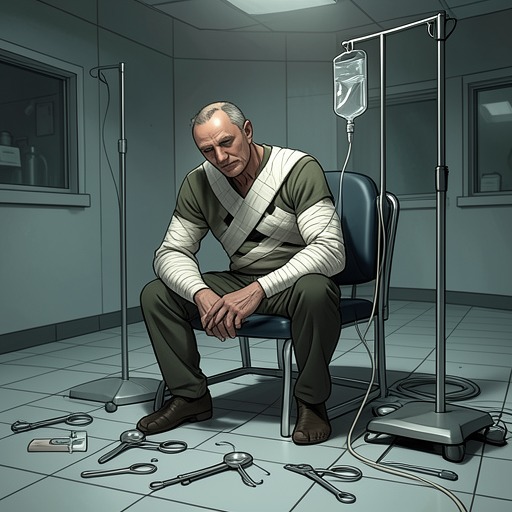
The contrast between routine and risk sharpens when another account describes searching for a vein in a bare foot. The addict is characterized as regarding the body impersonally, assessing its tissue with a trader’s coldness; a ravaged vein is dismissed as unusable. The syringe thus belongs to a practical vocabulary of access, suitability, and failure. The body is neither simply a passive container nor an unquestioned self: it is evaluated according to whether it can still serve the repeated act.
From private habit to systems of control
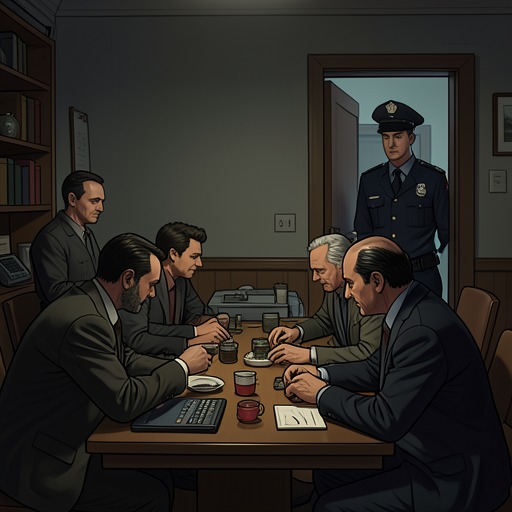
The novel also expands injection beyond an individual’s use of a syringe. Benway describes methods of psychological interrogation that combine drugs, hypnosis, and manipulation of a subject’s identity. In his account, an agent’s cover story can be reinforced until the agent identity falls outside conscious control, then approached through drugs and hypnosis. He also discusses sexual humiliation as a means of coercion, framing the body as a target of institutional technique. These passages do not make the syringe itself the central instrument, but place drug administration within a larger repertoire for controlling people.
A different extension appears in the account of the President’s dependence. Because of his position, he cannot take the drug directly and instead receives it through another person, who describes periodically recharging him. Their contact may look sexual to an observer, but the speaker says its central excitement lies in the separation when the recharge is complete. The method has changed over time: an initial bodily contact point has worn out, and another is used; an alternative, called an Osmosis Recharge, is treated as a defeat and is said to leave the President in a bad mood for weeks, with the possibility of grave political consequences. The syringe is not named as the means in this exchange. Rather, the episode extends its logic of dosing and dependence into a relationship that joins private need to the risks of office.
The State’s medical language supplies a further contrast. In a conversation with Carl Peterson, a doctor describes sexual deviation as sickness rather than something to be censored or sanctioned, then argues that public-health authorities may impose precautions to protect others. He explains that suspected tuberculosis can lead to a requested fluoroscopic examination and presents Carl’s summons as a kind of psychic fluoroscope, predicting a practically negative result. The scene does not describe a syringe, but places the novel’s imagery of bodily intervention beside an official rhetoric that presents examination and regulation as care. The instrument’s broader significance lies partly in this juxtaposition: treatment and control can share the language of procedure.
Recollection, repetition, and significance
The syringe also sits within a narrative that records drug use and memory in fragments rather than a single continuous history. One passage describes the other hand squeezing the user’s hand on waking, words taking on code significance, and diseases seeming to spell a message. Elsewhere, old photographs of Panama City recall Bill Gains and a scheme involving paregoric; an account of an overdose of Majoun records a sudden uncertainty about being in a villa outside Tangier. These recollections do not all concern a hypodermic syringe directly. Together, however, they show the kinds of association and disorientation surrounding the book’s drug-related scenes: objects and practices become points from which memory branches, without restoring a stable chronology.
A section describing the City and the Meet Cafe is explicitly identified as written in a state of Yage intoxication. Its accompanying notes render images as slow and silent, describe defenses falling away, and register a blue substance entering the speaker’s experience. This is a distinct drug state, not an account of syringe use; its relevance is formal. The book places sharply procedural scenes beside altered modes of perception, making the syringe one material anchor within a broader landscape of changing consciousness.
Finally, the novel’s concern with dependence reaches into relationships of bodily contact and separation, while its account of the President shows how a private dependency can acquire public stakes. The syringe remains a concrete device for preparing and delivering a dose, but its appearances also reveal a system: gestures become expertise, usable veins become scarce routes, and repeated relief gives way to renewed demand. Its force as an object comes from that conjunction of the mundane and the consequential, not from any single scene alone.